Axiom Math's AI agents formalize the classification of finite simple groups in Lean
Axiom Math said on 26 October 2026 that agent swarms formalized the classification of finite simple groups in 43.1 million lines of Lean in 24 days.
By Berkant A.Published
 Tech AI Latest
Axiom Math released on 26 October 2026 what it calls the first complete computer-checked proof of the classification of finite simple groups, a theorem whose original proof spans about 15,000 pages. Swarms of AI agents directed by Axiom's mathematicians and engineers wrote about 43.1 million lines of Lean in 24 days. The work found 34 noteworthy deviations from the published record and produced a new group theory result.
Key facts
- Released: 26 October 2026 (Axiom Math blog)
- Scale: about 43.1 million lines of Lean, 2.05 million declarations, 108 milestones
- Time: 24 days, with the project channel opened on 1 October 2026
- Findings: 34 noteworthy deviations from the published proof; counterexamples to a step in one route to the Unbalanced Group Theorem
- New result: Theorem 2.3, preservation of simple tops, proved by AxiomProver
- Not stated: which AI models the agents used, compute cost
What Axiom Math released
Axiom Math said on 26 October 2026 that it has released the first complete computer-checked proof of the classification of finite simple groups (CFSG). The theorem says every finite simple group is cyclic of prime order, alternating, of Lie type, or one of 26 sporadic groups. Its first-generation proof runs to roughly 15,000 pages in more than 500 articles by about 100 mathematicians, which is why Daniel Gorenstein called it "the enormous theorem".
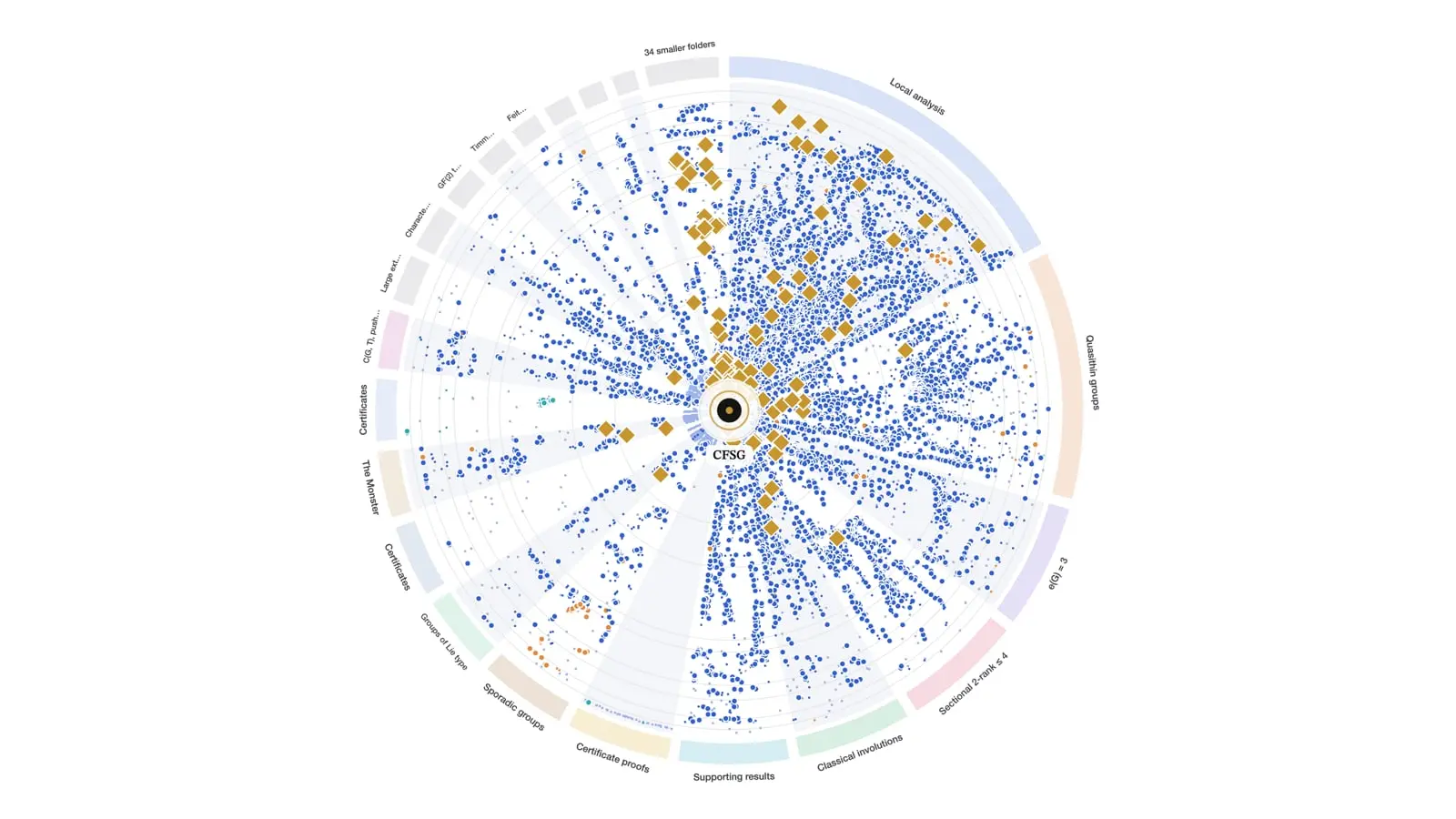
The formalization follows the first-generation proof, with every logical step checked by Lean's kernel. Axiom reports about 43.1 million lines of Lean and 2.05 million declarations. It builds on Mathlib and about 1.2 million lines from the earlier Qiuzhen-CFSG project. The code is public on GitHub.
How the agents did it
Axiom opened a coordination channel on 1 October 2026 and launched the first swarm the next day. A proof map built from the literature split the work into 108 milestones and about 380 tasks. Agents claimed tasks through GitHub issues, delegated missing prerequisites to other agents and reported results in Slack. Lead agents broke down hard arguments and reviewed statements, while human mathematicians handled mathematical obstructions and engineers kept the system running. The project took 24 days.
Axiom is open about early mistakes. Some milestones hid large prerequisites that agents had assumed rather than proved, and the team deleted tens of thousands of lines and restarted parts of the work. Axiom says humans checked that the final formal statement says what the classification says; Lean checked the deductions.
What the formalization found
Most problems in the published proofs were minor: typos, table errors and dropped hypotheses. Axiom counts 34 noteworthy deviations from the published record. The biggest concerned the Unbalanced Group Theorem, where Axiom found counterexamples to a closure assertion used in one published route, starting with the group PSL2(49). The counterexamples do not refute the theorem itself.
To close the gap, AxiomProver proved a new result, Theorem 2.3 on the preservation of simple tops, building on Ronald Solomon's 1976 theory of maximal 2-components. It is written up in a 35-page paper. Group theorists Richard Lyons and Ronald Solomon advised the team, and Axiom says it will publish the full errata with them.
Why it matters and what to watch
CFSG is used across algebra, number theory and combinatorics, usually cited in a line. A checkable version lets mathematicians trace exactly which results a step depends on. For AI research, the speed stands out: Axiom contrasts it with the 2012 Coq formalization of the much smaller Feit-Thompson theorem, a six-year team effort. It arrived the same day OpenAI released a model-written complexity theory preprint. Earlier milestones include Anthropic's Lean work on Fermat's Last Theorem. Watch for independent checks of the final Lean statement, the errata list and expert reaction to Theorem 2.3. More under AI Research.
What changed
| Before | The classification of finite simple groups existed only as a human proof spread over about 15,000 journal pages, never fully machine-checked |
|---|---|
| After | A complete Lean formalization of the first-generation proof, built by AI agents in 24 days, with 34 documented deviations and one new theorem |
| Who it affects | Group theorists, mathematicians who rely on the classification, and teams building AI systems for formal mathematics |
Questions people ask
- Has the classification of finite simple groups been formally verified?
- Axiom Math says yes: on 26 October 2026 it released a Lean formalization of the first-generation proof, with every step checked by Lean's kernel.
- How long did Axiom's formalization take?
- 24 days, according to Axiom, producing about 43.1 million lines of Lean.
- Did the formalization find errors in the original proof?
- Yes. Axiom reports 34 noteworthy deviations from the published record, including counterexamples to a step in one route to the Unbalanced Group Theorem, which it repaired with a new argument.
Sources
- Formalizing the Enormous Theorem (Axiom Math, 26 Oct 2026)
- The Classification of Finite Simple Groups, formalized in Lean (Axiom Math, 26 Oct 2026)
- AxiomMath/CFSG repository (Axiom Math, 26 Oct 2026)
Reference pages
- Axiom Math company
Spotted an error? See the corrections policy and tell the editor. Facts in this story come from the sources listed above; vendor claims are attributed.
Comments
Loading comments.