Google Cloud and NASA test a Pi0-driven robot for deep space crews, hitting 85% in the lab
Google Public Sector said on 27 October 2026 that a NASA robot prototype running a fine-tuned Pi0 model reached 85% baseline success on a lab task.
By Berkant A.Published
 Tech AI Latest
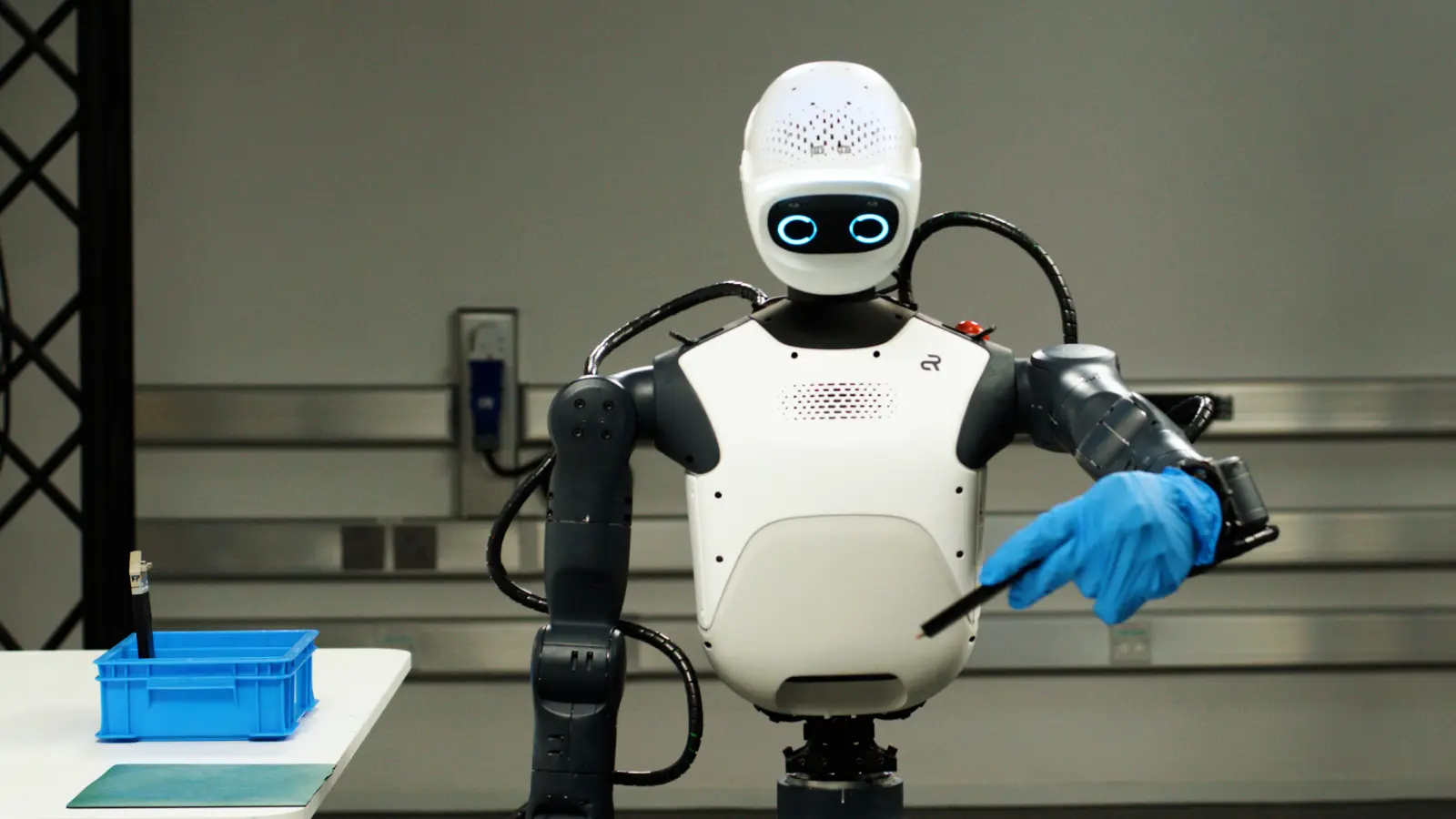
Google Public Sector said on 27 October 2026 that it built a proof-of-concept robotic system with NASA's Human Research Program, Johnson Space Center and JPL to help astronauts with cargo and medical tasks. A fine-tuned version of Physical Intelligence's open Pi0 model reached an initial 85% success rate on moving a medical bag in lab tests. Training took 2.5 hours on Google Cloud. Flight dates are not stated.
Key facts
- Announced: 27 October 2026 (Google Cloud blog)
- Partners: NASA Human Research Program, Johnson Space Center Robotics Team, JPL and Google Public Sector
- Model: open-source Pi0 (4 billion parameters) from Physical Intelligence, fine-tuned in 2.5 hours on Google Cloud G4 instances
- Result: 85% initial baseline success on a pick-and-place task with a medical bag, in early lab tests
- Edge hardware: about 15 edge computing devices tested over two years
- Not stated: flight tests, mission assignment, robot hardware maker
What Google and NASA announced
Google Public Sector said on 27 October 2026 that it has developed a proof-of-concept robotic system with NASA's Human Research Program, the Johnson Space Center Robotics Team and the Jet Propulsion Laboratory. The post is by Jim Kelly, vice president for federal at Google Public Sector.
The robot is meant as a general payload handler for a small crew on the Moon or on the way to Mars. In routine use it would move cargo, organise tools and secure compartments. When needed it would switch to medical support. The example given: if an astronaut has severe back pain that could signal kidney stones, the robot fetches and prepares an ultrasound machine while the human crew medical officer reads the scan and treats the patient.
The work builds on the Crew Medical Officer Digital Assistant, a clinical decision support system the two organisations described in 2025.
The model and the numbers
The robot runs the open-source Pi0 vision-language-action model from Physical Intelligence, which turns English text prompts into physical actions. The team fine-tuned the 4 billion parameter model in 2.5 hours on Google Cloud G4 instances. In a technology demonstration at Johnson Space Center's iMETRO facility, the robot had to find and move a medical bag. With an eye-to-hand camera setup it reached an initial baseline success rate of 85% in early lab environments. Google calls this a foundation for further training and safety work, not a finished system.
Movements were first practised in Google DeepMind's MuJoCo physics simulator before running on hardware. JPL adapted tools first built to track objects in orbit to help the robot understand its 3D surroundings from limited camera input. Because a spacecraft cannot rely on Earth data centres, the team checked that fine-tuned models run on small, low-power edge devices, testing about 15 of them over two years.
What changed and why it matters
The test points to robots that take open-ended instructions in plain language, the same approach labs are pursuing for homes and warehouses. The reason is latency: the post notes that a Mars round trip can mean up to 44 minutes of communication delay, which rules out remote control from Earth.
An 85% success rate on one task in a lab is far from flight readiness, and the post is clear that this is an early phase. It does not say which robot arm or platform was used, how many trials produced the 85% figure, or whether NASA has assigned the system to a mission. Physical Intelligence also offers its newer models through a paid API beta, but this project used the open Pi0 weights.
What to watch next
Google says the goal is a robot that takes voice instructions under direct astronaut supervision and could help with tasks such as taking vital signs or simple ultrasounds, without replacing human decisions. Watch for a published success rate after further training, tests in a spacecraft mock-up, and any link to Artemis Moon Base planning. More physical AI news is under Robotics & Physical AI.
What changed
| Before | Google and NASA had a software-only medical assistant for crews, the Crew Medical Officer Digital Assistant |
|---|---|
| After | A physical robot prototype driven by a fine-tuned Pi0 model reached 85% initial success on a lab pick-and-place task |
| Who it affects | NASA mission planners, astronaut crews on future Moon and Mars missions, and robot model developers targeting edge hardware |
Questions people ask
- What AI model does the NASA robot prototype use?
- The open-source Pi0 vision-language-action model from Physical Intelligence, a 4 billion parameter model the team fine-tuned in 2.5 hours on Google Cloud G4 instances.
- How well did the robot perform?
- It reached an initial baseline success rate of 85% on a pick-and-place task with a medical bag in early lab tests, according to Google Public Sector.
- Will the robot fly on an Artemis mission?
- Not stated in the announcement. Google describes it as a proof of concept that could assist astronauts on future NASA missions.
Sources
- Google Cloud and NASA: Testing robotic systems for deep space missions (Google Cloud, 27 Oct 2026)
Reference pages
- Google company
- NASA company
- Physical Intelligence company
Spotted an error? See the corrections policy and tell the editor. Facts in this story come from the sources listed above; vendor claims are attributed.
Comments
Loading comments.