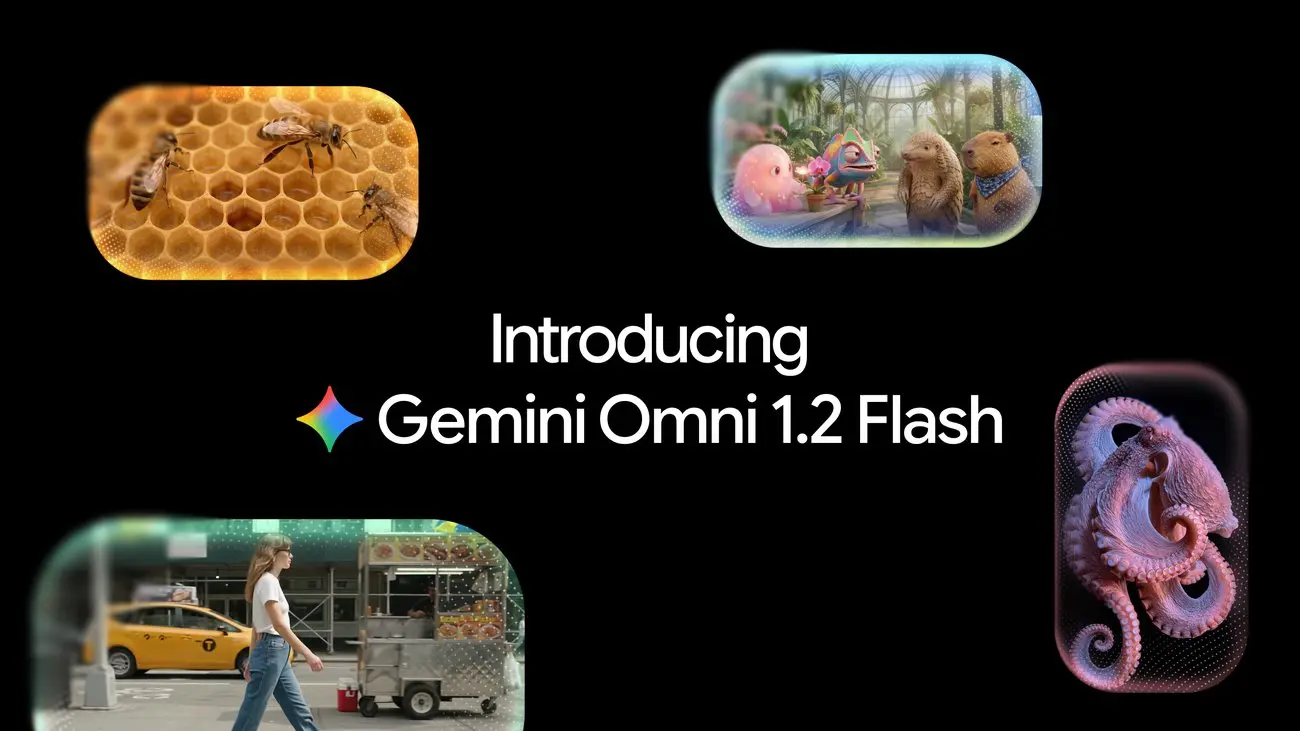
Gemini Omni 1.2 Flash brings 15-second video clips at a 30% lower price, Google says
Google released Gemini Omni 1.2 Flash on 5 November 2026: video generation and editing up to 15 seconds, better speech and lip-sync, and $0.07 per second at 720p.
By Gürkan E.Published
 Tech AI Latest
Google released Gemini Omni 1.2 Flash on 5 November 2026, an update to its fast video generation and editing model. Clips can now run up to 15 seconds instead of 10, speech and lip-sync are improved, and multi-turn editing works across the full clip. Google lists the price at $0.07 per second of 720p video, 30% below Gemini Omni 1.1 Flash. It is generally available in the Gemini API, Gemini for business and Google Cloud.
Key facts
- Released: 5 November 2026 (Google)
- Maximum clip length: 15 seconds, up from 10 seconds in Gemini Omni 1.1 Flash
- Price: $0.07 per second of 720p video, 30% lower than 1.1 Flash, per Google Cloud
- Availability: generally available in the Gemini API, Gemini for business and Google Cloud; rolling out in Flow; in Google Vids
- Gemini app: 15-second clips for Google AI Ultra subscribers
- Not stated: independent quality benchmarks
What Google released
Google released Gemini Omni 1.2 Flash on 5 November 2026, describing it in its post Gemini Omni 1.2 Flash: Fast and cost-effective with longer clips as an update to the faster, cheaper member of the Gemini Omni video family built by Google DeepMind. The model generates video with sound from text, images and video prompts, and it can also edit existing clips. Google says the new version is generally available through the Gemini API and Gemini for business, and a separate Google Cloud post confirms general availability on Google Cloud.
The headline change is length. Gemini Omni 1.1 Flash was limited to clips of 10 seconds, and version 1.2 raises the limit to 15 seconds for both generation and editing. In its developer post on X, Google described the release as bringing higher quality and consistency, native 15-second video generation and editing, and 30% lower pricing. The Google AI account added that the team had worked on how scenes hold together over time, upgraded character speech and reduced visual glitches such as jump cuts.
Speech is the second area Google highlights. The company says the model produces more fluid and natural-sounding dialogue, clearer lip-sync, and distinct conditioning for multiple speakers, so that two or more characters in the same scene can be told apart. Video models have struggled to keep mouths in time with generated audio, and this is a claim that users will test quickly; one third-party test cited in launch coverage reported that lip-sync drift becomes noticeable in longer clips, so the improvement should be treated as Google's claim until wider testing is available.
The third change is editing. Google says multi-turn conversational editing now works across full 15-second clips. A user can ask the model to swap a product or a background, change the lighting or the weather, or switch the aspect ratio, one turn at a time, instead of generating a new clip from scratch for each change. Google also says reference following has improved, meaning the model sticks more closely to images or clips supplied as a guide for how characters, products or settings should look. Google has not published independent benchmark results for the update in the material reviewed here.
Price and where it is available
Google lists the price of Gemini Omni 1.2 Flash at $0.07 per second of 720p video, which it says is 30% lower than Gemini Omni 1.1 Flash. At that rate a full 15-second clip at 720p costs about $1.05 before any discounts, based on the listed per-second price. Prices for other resolutions vary by provider: OpenRouter, which resells access to the model, lists rates from about two cents per second at 360p up to about 21 cents per second at 4K, with audio included. Those reseller prices are not Google's own list prices and can change.
The model reaches several Google products at once. Developers get it through the Gemini API and Google AI Studio, and businesses through Gemini for business and the Google Cloud console. For creative teams, Google says the model is rolling out in Flow, its filmmaking tool, and the Google Workspace Updates blog says Gemini Omni 1.2 Flash is now available directly in Google Vids with 15-second generations and improved quality. In the consumer Gemini app, Google says 15-second clips are available to Google AI Ultra subscribers.
What changed and what to watch
Gemini Omni sits alongside Google's other video work. The company's world model Genie 4, previewed in October, uses Gemini Omni to anchor the look and behaviour of generated scenes, while other Gemini models keep the simulation coherent. Improvements to Omni therefore feed into more than the standalone video tools. The Flash tier is the cheaper and faster option in the family, aimed at volume use in products and in advertising, rather than at the highest possible quality for film work.
Several details are not stated in the announcement material reviewed for this story. Google has not published a model card with independent quality scores, the maximum resolution for each surface, or the date when the Flow rollout will reach all users. It is also not clear from the launch posts whether the 15-second limit applies at every resolution or only at some, or how long Gemini Omni 1.1 Flash will remain available for developers who have built on it. The site's model release tracker lists the release with the per-second price, and the Gemini Omni 1.2 Flash page collects the specs that Google has confirmed.
For developers already using Gemini Omni 1.1 Flash, the practical step is to test the new model on their own prompts before switching, since the price cut and longer clips only help if quality holds for their use case. For businesses on Google Workspace, the arrival in Vids means that staff can produce short clips inside a tool they already have, which brings questions about review and approval of generated video into ordinary office work. More on Google's models is on the Google DeepMind page and in the site's AI models section.
What changed
| Before | Gemini Omni 1.1 Flash: clips up to 10 seconds at a higher per-second price. |
|---|---|
| After | Gemini Omni 1.2 Flash: clips up to 15 seconds, improved speech and lip-sync, multi-turn editing across the full clip, $0.07 per second at 720p. |
| Who it affects | Developers on the Gemini API and Google Cloud, Google Vids and Flow users, and Google AI Ultra subscribers in the Gemini app. |
Questions people ask
- How long can Gemini Omni 1.2 Flash videos be?
- Up to 15 seconds for both generation and editing, according to Google, up from 10 seconds in Gemini Omni 1.1 Flash.
- How much does Gemini Omni 1.2 Flash cost?
- Google lists $0.07 per second of 720p video, which it says is 30% less than Gemini Omni 1.1 Flash.
- Where can I use Gemini Omni 1.2 Flash?
- Google says it is generally available in the Gemini API, Gemini for business and Google Cloud, is rolling out in Flow, is available in Google Vids, and offers 15-second clips to Google AI Ultra subscribers in the Gemini app.
Sources
- Gemini Omni 1.2 Flash: Fast and cost-effective with longer clips (Google, 5 Nov 2026)
- Gemini Omni 1.2 Flash now GA: cost-effective video (Google Cloud, 5 Nov 2026)
- Gemini Omni 1.2 Flash now in Vids with 15-second generations and improved quality (Google Workspace Updates, 5 Nov 2026)
- Google's Gemini Omni 1.2 Flash stretches AI video clips to 15 seconds and cuts pricing by 30 percent (The Decoder, 5 Nov 2026)
- Google announces Gemini Omni 1.2 Flash with the ability to make 50% longer video clips (Android Authority, 5 Nov 2026)
Reference pages
- Gemini Omni 1.2 Flash model
- Google DeepMind company
- Google company
- Gemini app tool
Spotted an error? See the corrections policy and tell the editor. Facts in this story come from the sources listed above; vendor claims are attributed.
Comments
Loading comments.