NVIDIA and SETI Institute run AI agents on the Allen Telescope Array at 2.4 Tbps
Breakthrough Listen and the SETI Institute now let AI agents steer the Allen Telescope Array and process up to 2.4 Tbps of data on NVIDIA GPUs, NVIDIA says.
By Emre A.Published
 Tech AI Latest
NVIDIA said on 30 October 2026 that Breakthrough Listen and the SETI Institute have brought agentic AI into the daily search for extraterrestrial intelligence. At the Allen Telescope Array in northern California, agents can steer the antennas, calibrate the instrument, fix data errors and run AI models on the live stream from one natural language request. The system handles 2.4 terabits per second on RTX PRO 6000 Blackwell GPUs and made a first real-time AI detection of a pulsar.
Key facts
- Announced: 30 October 2026, NVIDIA blog
- Partners: Breakthrough Listen and the SETI Institute, at the Allen Telescope Array, Hat Creek, California
- Throughput: 2.4 terabits per second on NVIDIA RTX PRO 6000 Blackwell GPUs, inference on premises
- Software: NVIDIA Holoscan with the DAQIRI library, the CyberEther signal framework and the Nexus orchestrator
- Result: first real-time AI detection of a pulsar, in the Crab Nebula, according to NVIDIA
- Not stated: start date of agent operations, which AI models are in use today, and any candidate signals found
What NVIDIA and the SETI Institute announced
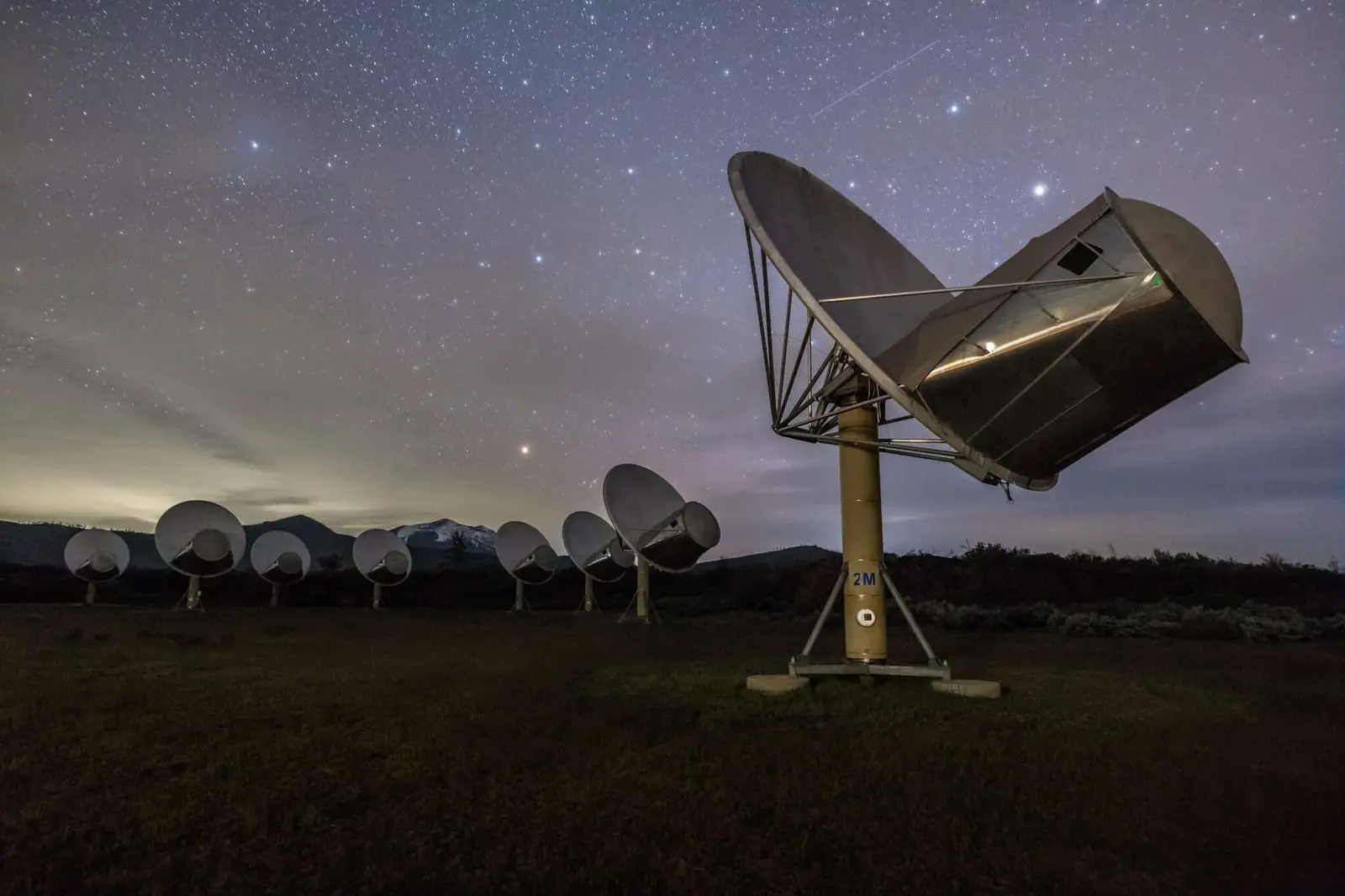
NVIDIA said in a blog post on 30 October 2026 that Breakthrough Listen and the SETI Institute are bringing agentic AI into the daily search for extraterrestrial intelligence. At the Allen Telescope Array, a 42-dish radio telescope at Hat Creek Radio Observatory in northern California, agents can steer the instrument, enhance and correct incoming data and apply AI models to the live stream, all from one natural language request.
Andrew Siemion, Bernard M. Oliver chair for SETI at the SETI Institute and principal investigator of Breakthrough Listen, described the agentic observatories as a breakthrough in translation rather than something to fear.
How the pipeline works
Radio telescopes produce data faster than it can be stored. NVIDIA says DAQIRI, a library of its Holoscan sensor-processing platform, pulls terabits per second of sensor data straight into GPU memory, so observations are processed in flight instead of filling hard drives. CyberEther, a signal-processing framework developed at the SETI Institute, does the maths with CUDA-X libraries including cuFFT and cuBLAS.
Nexus, a web-based observatory orchestrator, is the agent harness. It gives agents one source of truth for instrument state, compute and pipelines, and lets researchers check packet loss, read live spectrograms and rewrite signal-processing blocks by prompting. NVIDIA says the system handles 2.4 terabits per second on RTX PRO 6000 Blackwell GPUs, with inference next to the instrument, and that agents compress work that would take people weeks or years into hours. That is a vendor claim; the post gives no benchmark.
Why it matters
The pipeline has already made what NVIDIA calls the first real-time AI detection of a pulsar, in the Crab Nebula. A pulsar is a known natural source, so this is a test of the system rather than a SETI result. The change is operational: one instrument can now be pointed, calibrated and checked by software agents during an observation, which matters when interesting signals may be brief. It extends a pattern seen in other AI for science work, where agents run lab or field equipment directly, such as the Google Cloud and NASA robotics project.
What to watch next
NVIDIA says the team is evaluating open models, including Nemotron, where data locality and turnaround matter most, and for observatories that might one day run offline on the far side of the Moon. The post does not say when agents began operating at the array, how often they run without human review, or whether any candidate technosignature has been flagged.
What changed
| Before | Allen Telescope Array observations were steered, calibrated and checked by researchers, with data handled through conventional pipelines |
|---|---|
| After | AI agents can steer and calibrate the array and analyse up to 2.4 Tbps of live data on NVIDIA GPUs from a natural language request, NVIDIA says |
| Who it affects | SETI and radio astronomy researchers; observatories planning on-site AI processing |
Questions people ask
- What can the AI agents at the Allen Telescope Array do?
- According to NVIDIA, they can steer the antennas, calibrate and focus the instrument, catch and fix data errors, apply AI models to incoming data and plot results, all from one natural language request.
- Has the system found an alien signal?
- No such claim is made. NVIDIA reports a first real-time AI detection of a pulsar in the Crab Nebula, a known natural object.
- Which NVIDIA hardware runs the system?
- NVIDIA RTX PRO 6000 Blackwell GPUs, handling 2.4 terabits per second with inference on site, using the Holoscan platform and CUDA-X libraries.
Sources
- AI Joins the Search for Extraterrestrial Signals (NVIDIA, 30 Oct 2026)
- The Allen Telescope Array (ATA) (SETI Institute, 30 Oct 2026)
- CyberEther: GPU-accelerated signal processing (CyberEther, 30 Oct 2026)
Reference pages
- NVIDIA company
- SETI Institute company
Spotted an error? See the corrections policy and tell the editor. Facts in this story come from the sources listed above; vendor claims are attributed.
Comments
Loading comments.